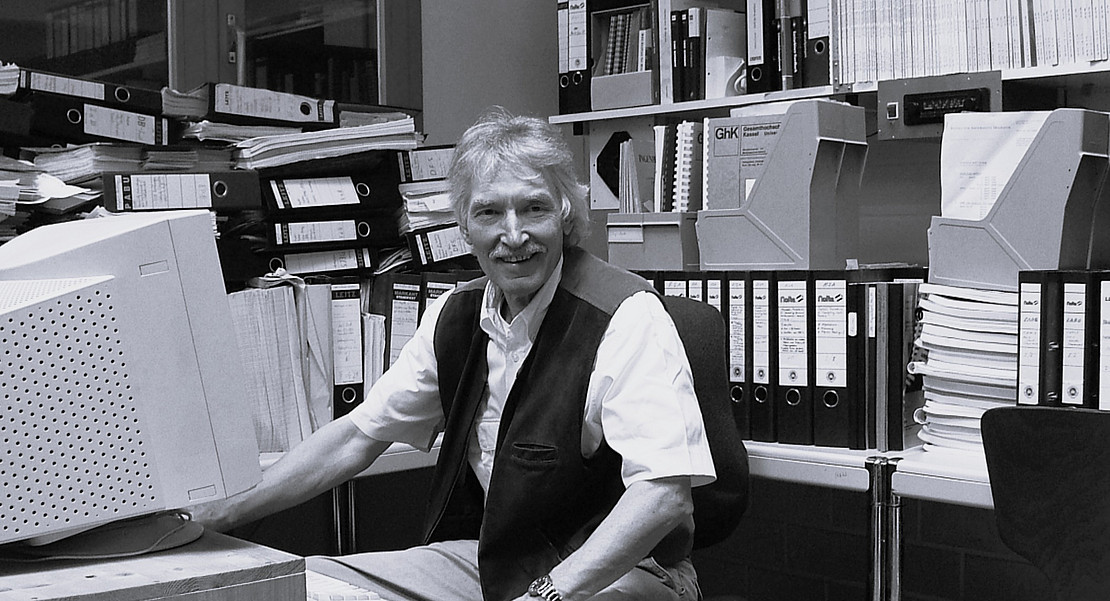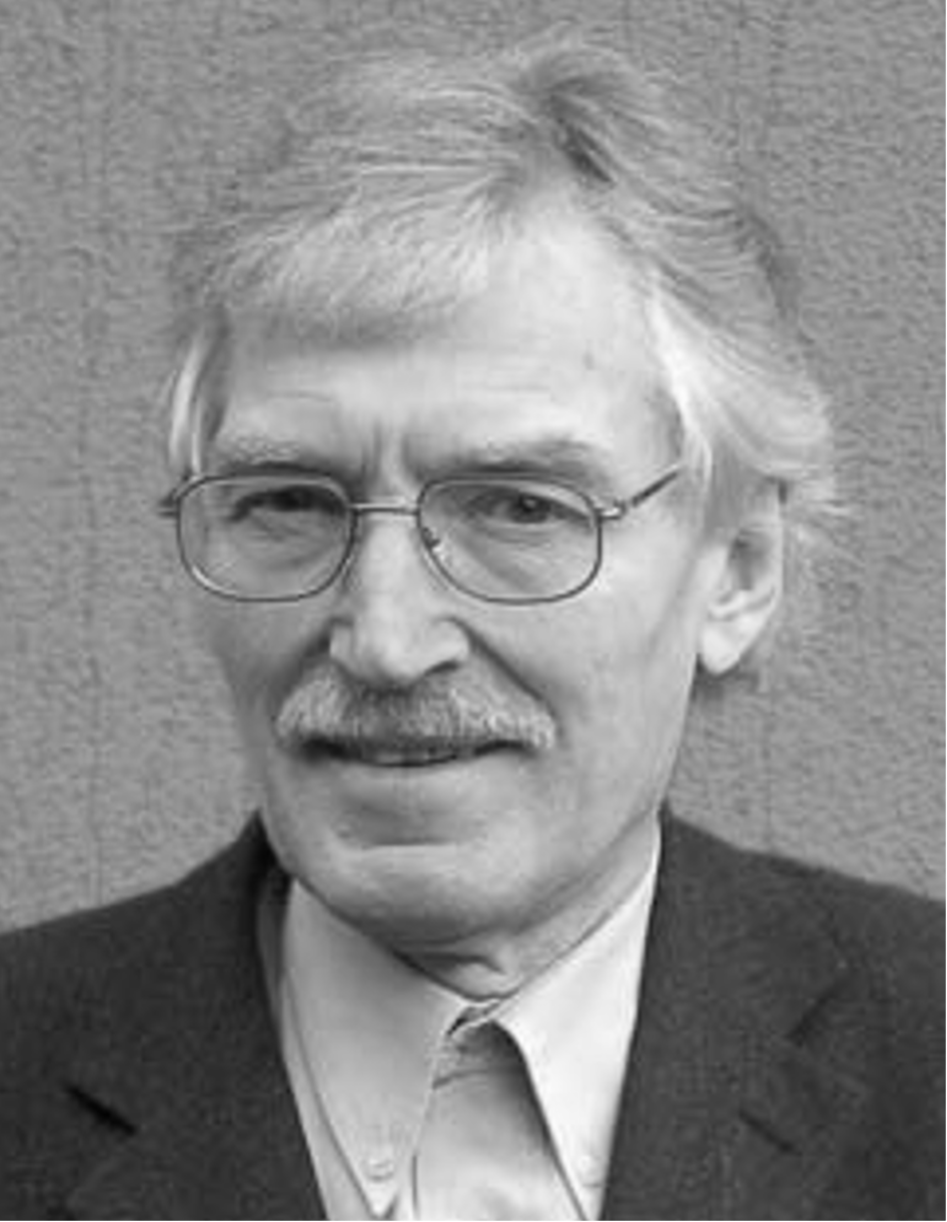
After graduating from high school in Mayen near Koblenz, Michael Link studied civil engineering at the Technical University of Darmstadt from 1961 to 1967. From 1968 to 1972, he was a research assistant at the Chair of Lightweight Construction in the Department of Mechanical Engineering. After completing his doctorate in 1972 in the field of "Hybrid finite elements in stability theory" (reported by Prof Klöppel and Prof Wissmann) in the Department of Civil Engineering at the Technical University of Darmstadt, he moved to industry.
There he worked from 1973 to 1980 at Dornier System GmbH, Friedrichshafen, as a calculation engineer and from 1975 took over the management of the structural calculation and testing department and thus aerospace projects.
In 1980, he accepted an appointment as a university professor and head of the Department of Lightweight Construction at the University of Kassel (formerly Gesamthochschule Kassel). He headed the department, which later became part of the Institute of Structural Analysis and Structural Dynamics, until his retirement in 2006. In addition to research, he taught lightweight construction, finite element methods (FEM) and mechanics and set up a laboratory and technical centre for experimental vibration analysis.
He then continued his scientific work and was involved in various high-calibre research and development projects. Naturally, he was a sought-after speaker at national and international seminars, conferences and congresses. But he was also active in industry as a consultant and expert, e.g. for wind turbines and bridges. Particularly noteworthy here is the ongoing monitoring of the Gärtnerplatz Bridge in Kassel to assess the serviceability and load-bearing safety over the service life of this structure.
In general, his research focussed on experimental and numerical structural mechanics, particularly in the areas of FEM and the identification of mechanical structures from civil and mechanical engineering. He recognised the importance and possibilities of numerical model updating and model-based structural health monitoring at an early stage. He has published well over 150 nationally and internationally recognised scientific articles on this subject.
He was also a member of several industry-related associations and national and international scientific advisory boards. His membership of the editorial board of the renowned and excellent journals "Mechanical Systems and Signal Processing" and "Encyclopedia of Vibrations" is particularly noteworthy.
He has also written three books, including the book "Finite Elemente in der Statik und Dynamik", which was published in 1984 and can be described as a standard work.
Micheal Link's industrial focus was to transfer his research into the development and application of computer-orientated methods, with which he calculated, checked and metrologically validated static and dynamic loads and properties of structures, into real applications. The aim was always to improve the accuracy of computer models and thus optimise design processes, increase the degree of utilisation of materials and analyse the safety of structures. These methods were used, for example, for overhead contact lines at high train speeds, for the vibration analysis of many existing and new bridge structures and also for solving vibration problems in historical buildings such as Kassel Castle, to name but a few.
Michael Link also saw it as an important task to pass on his theoretical knowledge and practical experience to the next generation. He was always happy to supervise doctoral students and was the first supervisor of around 20 outstanding doctorates.
Michael Link is associated with the VDI and its committees in many ways. For example, he has been a member of the programme committee of the VDI conference “Schwingungen” (vibrations) for many years. He has also been a member of the programme committee of the VDI conference on “Baudynamik” (structural dynamics) from the very beginning, which was held in Kassel for the first time in 2003 thanks to his active support. Conferences on the “Dynamik von Windenergieanlagen” (dynamics of wind turbines) were also particularly close to his heart. His esteem among colleagues is also documented by his inclusion in the "Board of Excellence" of these conferences. He was also active in many other specialist committees, such as “Gebrauchstauglichkeit von Bauwerken bei dynamischen Einwirkungen” (serviceability of structures under dynamic loads) or “Strukturüberwachung und Beurteilung von Windenergieanlagen und Plattformen” (structural monitoring and assessment of wind turbines and platforms), with great commitment and success. His extensive knowledge and experience in these areas, as well as his many years of involvement with the DGZfP in the development of guidelines such as “Zustandsüberwachung von Bauwerken” (condition monitoring of structures) and “Automatisierte Dauerüberwachung im Ingenieurbau” (automated long-term monitoring in civil engineering), made a decisive contribution to the success of these standards and guidelines. The appreciation of this work was expressed by the award of the VDI Medal of Honour.
Through our joint work in the fields of structural dynamics, vibration analysis and structural monitoring, we got to know Michael personally as a warm-hearted, sincere and imaginative systematic thinker over 40 years. In the various committees in which we worked together, his intelligent and balanced theoretical and practical suggestions often quickly led to excellent solutions to problems.
With Michael's passing, his family loses a dear father, grandad, life partner, etc. Michael's "old colleagues" are losing a very honourable and top-class colleague, scientist and friend.
Take care Michael!
W. Rücker, BAM Berlin
A. Lenzen, I4S HTWK-Leipzig
M. Weiland, UK Kassel